
Valuation under Income Tax Provisions
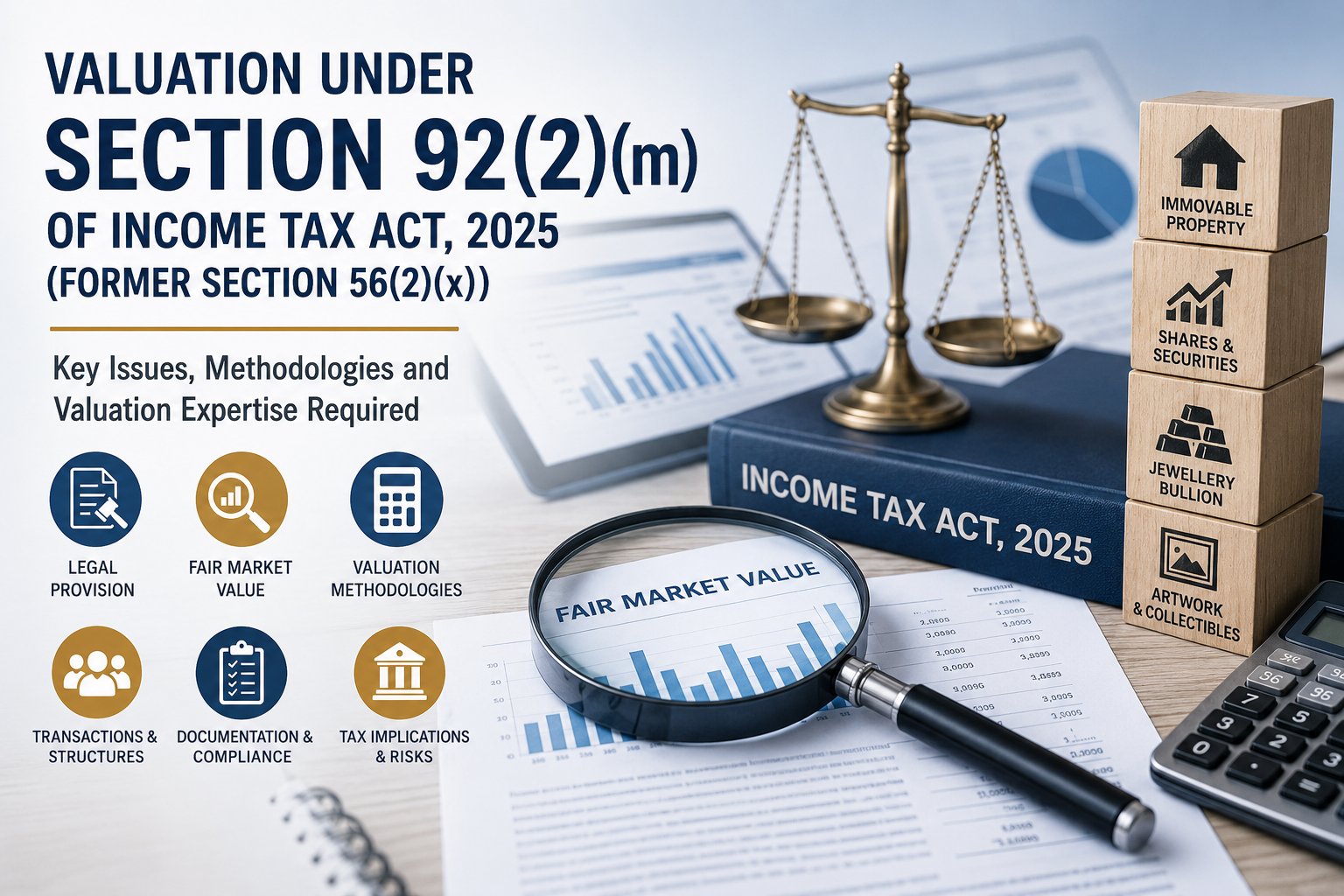
Valuation under Section 92(2)(m) of the Income-tax Act, 2025 (Earlier Section 56(2)(x)): Valuation Challenges, Methodologies and Role of the Valuation Professional
Introduction
The Income-tax Act, 2025 has substantially reorganized and renumbered the provisions of the erstwhile Income-tax Act, 1961. One such provision is Section 92(2)(m), which broadly corresponds to the erstwhile Section 56(2)(x) dealing with taxation of property received without consideration or for inadequate consideration.
The provision is commonly referred to as the “deemed income” or “gift taxation” provision. While originally intended to curb tax avoidance through transfer of assets at artificially low values, it has evolved into one of the most valuation-intensive provisions under Indian tax law.
The importance of valuation under this section cannot be overstated. Unlike many tax provisions where valuation affects only the quantum of tax, under Section 92(2)(m), valuation itself determines whether a taxable event has occurred. Consequently, valuation reports are frequently scrutinized during assessments, litigation, restructuring transactions, family settlements, startup funding rounds, shareholder transfers and succession planning.
Legislative Framework
Section 92(2)(m) provides that where a person receives specified property:
- Without consideration; or
- For consideration lower than its Fair Market Value (FMV),
the difference between FMV and consideration may become taxable under the head “Income from Other Sources”, subject to prescribed thresholds and exemptions.
The provision covers:
1. Money
Any sum of money received without consideration exceeding ₹50,000.
2. Immovable Property
Land or building received:
- Without consideration; or
- For inadequate consideration.
3. Specified Movable Property
Including:
- Shares and securities
- Jewellery
- Bullion
- Archaeological collections
- Drawings
- Paintings
- Sculptures
- Works of art
where the aggregate FMV exceeds the prescribed threshold.
Why Valuation is Critical
The entire operation of Section 92(2)(m) revolves around FMV.
A difference of opinion regarding valuation may result in:
- Additional tax liability.
- Interest exposure.
- Penalty proceedings.
- Litigation before appellate authorities.
- Recharacterization of commercial transactions.
In practice, valuation disputes most frequently arise in relation to:
- Unquoted equity shares.
- Startup investments.
- Family settlements.
- Inter-group transfers.
- Shareholder exits.
- ESOP transactions.
- Buy-back and restructuring transactions.
Assets Requiring Valuation
A. Unquoted Equity Shares
This is the most common valuation assignment under the section.
Examples include:
- Transfer of shares between promoters.
- Transfer between family members not covered under exemption provisions.
- Secondary share sale transactions.
- Employee share transfers.
- Investor exits.
- Mergers and restructuring exercises.
The valuation generally follows prescribed rules corresponding to the successor provisions of Rule 11UA. FMV determination remains a highly technical exercise requiring professional judgment.
B. Preference Shares and Securities
Valuation may be required for:
- Compulsorily Convertible Preference Shares (CCPS)
- Optionally Convertible Preference Shares (OCPS)
- Debentures
- Warrants
- Convertible instruments
The challenge arises because these instruments often possess rights significantly different from ordinary equity.
C. Jewellery and Bullion
Valuation generally requires:
- Physical verification.
- Purity assessment.
- Market benchmarking.
- Expert certification.
D. Artwork and Collectibles
Valuation often involves:
- Authenticity verification.
- Provenance review.
- Comparable market transactions.
- Specialist appraisers.
E. Immovable Property
Although stamp duty value is generally adopted as the benchmark, valuation issues continue to arise where:
- Stamp duty values are excessive.
- Property characteristics differ from assumptions made by stamp authorities.
- Valuation Officer references are sought.
The Assessing Officer may refer disputed cases to a Valuation Officer in specified circumstances.
Valuation Methodologies for Unquoted Shares
The most significant valuation work under Section 92(2)(m) relates to unlisted shares. While the equity shares are valued using a rigid Asset based formula, the other securities should be valued using the standard valuation methodologies. Hence an understanding of all methodologies is important in the current environment where the different kind of instruments are issued by companies.
1. Net Asset Value (NAV) Method
Historically, Rule-based valuation has relied heavily upon NAV methodology.
Formula-Based Approach
The method considers:
- Book value of assets.
- Adjustments for specified exclusions.
- Liabilities.
- Paid-up equity capital.
Suitable where:
- Asset-rich entities exist.
- Holding companies predominate.
- Investment companies are involved.
Advantages
- Objective.
- Easy to verify.
- Less dependent on projections.
Limitations
- Ignores future earning potential.
- Often unsuitable for startups.
- May significantly undervalue intellectual property.
2. Discounted Cash Flow (DCF) Method
DCF estimates value based on future expected cash flows.
Common Uses
- Technology companies.
- Growth-stage businesses.
- Venture-backed entities.
- Knowledge-driven businesses.
Key Inputs
- Revenue projections.
- EBITDA margins.
- Capital expenditure.
- Working capital assumptions.
- Terminal growth rate.
- Discount rate.
Major Risks
DCF valuations are frequently challenged where:
- Forecasts lack support.
- Assumptions are unrealistic.
- Business plans are not contemporaneously available.
3. Market Approach
This approach derives value from:
- Comparable listed companies.
- Comparable transactions.
- Recent funding rounds.
Common multiples include:
- EV/Revenue
- EV/EBITDA
- P/E Ratio
- Price-to-Book
4. Hybrid Approaches
In sophisticated assignments, valuers often use:
- DCF plus market cross-check.
- NAV plus earnings adjustments.
- Multi-scenario valuation models.
These are particularly useful for startups and businesses with mixed asset and earnings characteristics.
Key Valuation Issues under Section 92(2)(m)
Issue 1: Transfer Price versus FMV
A transaction may be commercially negotiated at a price lower than tax FMV.
Examples:
- Distress sales.
- Minority stake transfers.
- Family arrangements.
- Strategic exits.
The tax law may nevertheless seek to substitute FMV.
The valuer must therefore distinguish between:
- Actual transaction value.
- Fair Market Value prescribed under tax law.
Issue 2: Minority Shareholding Discounts
A recurring controversy is whether a minority stake should be valued differently from a controlling stake.
Questions frequently arise regarding:
- Lack of control.
- Lack of marketability.
- Transfer restrictions.
The valuation professional must clearly explain the rationale adopted.
Issue 3: Startup Valuations
Startups frequently exhibit:
- Negative earnings.
- Limited operating history.
- Significant intellectual property.
- High growth expectations.
Traditional NAV methods often fail to capture economic value.
Accordingly, substantial professional judgment is required when evaluating:
- Forecast credibility.
- Fundraising history.
- Venture capital terms.
- Exit assumptions.
Issue 4: Down Rounds and Secondary Transfers
A significant issue under the new law is whether shares issued or transferred at a price below rule-based FMV may trigger taxation in the hands of the recipient.
This has become particularly relevant in:
- Down-round financing.
- Anti-dilution issuances.
- Founder share transfers.
- Employee liquidity programs.
Issue 5: Intangible Assets
Many businesses derive value from:
- Brands.
- Software.
- Customer relationships.
- Patents.
- Proprietary technology.
Valuation professionals must evaluate whether book values adequately reflect these assets.
Required Expertise of the Valuation Professional
Section 92(2)(m) assignments require substantially more than mechanical rule application.
A competent valuer should possess expertise in:
Financial Analysis
Including:
- Financial statement analysis.
- Forecast review.
- Industry benchmarking.
- Capital structure assessment.
Valuation Methodologies
Knowledge of:
- Income Approach.
- Market Approach.
- Asset Approach.
- Option pricing techniques.
- Convertible instrument valuation.
Tax Law Interpretation
The valuer should understand:
- Section 92(2)(m).
- Rule 57 (successor to Rule 11UA).
- Related valuation provisions.
- Judicial precedents.
- CBDT guidance and notifications.
Corporate Transactions
Experience in:
- Fund raising.
- Mergers and acquisitions.
- Shareholder exits.
- ESOP transactions.
- Family settlements.
Litigation Support
Many valuation reports ultimately become evidence in assessment or appellate proceedings.
Accordingly, the valuer must:
- Maintain detailed working papers.
- Support assumptions with evidence.
- Explain methodology selection.
- Demonstrate consistency.
Best Practices for Valuation Reports
A robust valuation report should contain:
Executive Summary
- Purpose of valuation.
- Asset being valued.
- Valuation date.
Company Overview
- Business description.
- Industry analysis.
- Ownership structure.
Financial Analysis
- Historical performance.
- Normalization adjustments.
- Key drivers.
Valuation Methodology
- Methods considered.
- Reasons for acceptance or rejection.
- Detailed calculations.
Assumptions
- Growth rates.
- Discount rates.
- Market multiples.
- Economic outlook.
Sensitivity Analysis
Particularly for DCF-based valuations.
Conclusion
- Final FMV.
- Basis of conclusion.
- Limiting conditions.
Common Mistakes Observed in Practice
- Blind reliance on management projections.
- Using stale financial information.
- Ignoring recent transactions in company shares.
- Inadequate documentation of assumptions.
- Failure to consider shareholder rights.
- Inconsistent valuation approaches across transactions.
- Treating Rule-based valuation as a purely mathematical exercise.
- Ignoring valuation implications of preference shares and convertibles.
Conclusion
Section 92(2)(m) of the Income-tax Act, 2025, which replaces the erstwhile Section 56(2)(x), continues to be one of the most valuation-sensitive provisions in Indian tax law. The provision taxes property received without consideration or for inadequate consideration and therefore places Fair Market Value at the center of tax compliance.
For valuation professionals, the challenge extends beyond applying prescribed formulas. A defensible valuation requires a thorough understanding of valuation theory, tax regulations, corporate finance, securities rights, and practical transaction dynamics. As tax authorities increasingly scrutinize private company valuations, the quality, documentation, and technical robustness of valuation reports will remain critical in managing tax risk and supporting successful assessments and litigation outcomes.