Valuation for Mergers, Amalgamations and Demergers in India
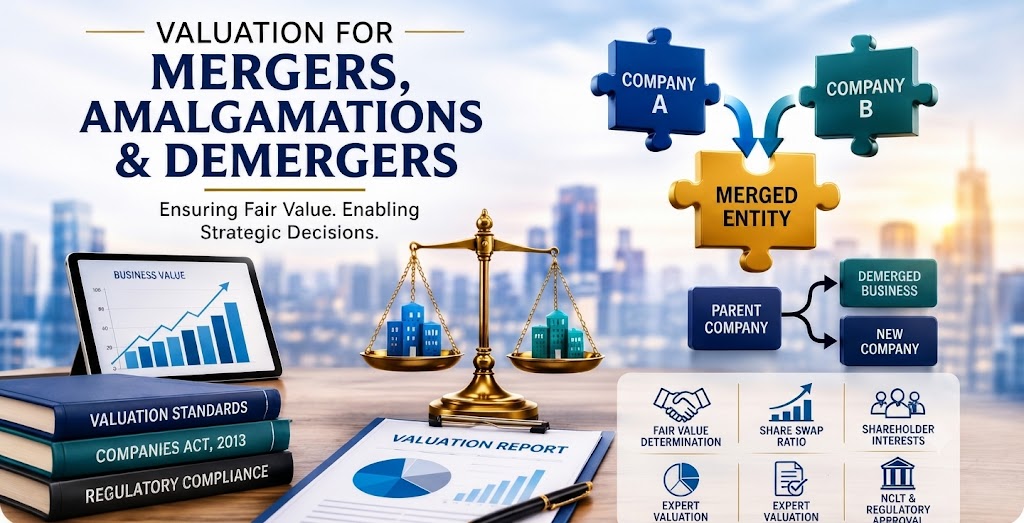
Valuation for Mergers, Amalgamations and Demergers in India: Regulatory Framework, Methodologies and the Role of the Valuation Professional
Introduction
Mergers, amalgamations and demergers are among the most significant corporate restructuring transactions undertaken by businesses. Whether driven by strategic growth, operational synergies, succession planning, group reorganization, unlocking shareholder value, or regulatory requirements, such transactions invariably require an independent valuation exercise.
Unlike a normal business valuation where the objective is to determine the value of a single company, restructuring valuations focus primarily on determining the relative value of the entities or businesses involved. The ultimate outcome is generally a share exchange ratio (swap ratio) or share entitlement ratio, which determines how ownership will be allocated among shareholders after the transaction.
Under the Companies Act, 2013, valuation plays a central role in ensuring fairness, transparency and protection of shareholder interests. A poorly supported valuation can result in objections from shareholders, regulators, stock exchanges, Regional Directors, Official Liquidators or the National Company Law Tribunal (NCLT).
Regulatory Framework
Companies Act, 2013
The primary provisions governing mergers, amalgamations and demergers are:
- Section 230 – Compromises and Arrangements
- Section 231 – Powers of the Tribunal
- Section 232 – Mergers and Amalgamations
- Section 233 – Fast Track Mergers
- Section 236 – Purchase of Minority Shareholding
Valuation reports are commonly circulated to shareholders and creditors as part of the scheme documentation and are frequently examined during NCLT proceedings.
Registered Valuer Framework
In most restructuring transactions, the valuation report is prepared by an:
IBBI Registered Valuer (Securities or Financial Assets Class)
The valuation must generally comply with:
- Companies Act, 2013
- Companies (Registered Valuers and Valuation) Rules, 2017
- ICAI Valuation Standards
- International Valuation Standards (where relevant)
- SEBI Regulations (for listed companies)
Additional Regulations for Listed Companies
Where listed companies are involved, additional requirements may arise under:
- SEBI (LODR) Regulations
- SEBI Scheme of Arrangement Framework
- Stock Exchange Observation Letters
- Fairness Opinion from a SEBI Registered Merchant Banker
The valuation therefore undergoes scrutiny not only from shareholders but also from stock exchanges and market regulators.
Why Valuation is Required
Valuation serves multiple purposes in restructuring transactions.
Determination of Share Exchange Ratio
The most common purpose.
Example:
If Company A is valued at ₹1,000 per share and Company B is valued at ₹500 per share, shareholders of Company B may receive one share of Company A for every two shares held in Company B.
The valuation therefore determines the economic rights of shareholders after the merger.
Protection of Minority Shareholders
The valuation must ensure that:
- No class of shareholders is unfairly prejudiced.
- The transaction is commercially fair.
- Ownership dilution is justified.
Courts and regulators often focus on whether the valuation methodology has treated all stakeholders fairly.
Regulatory Approval
Valuation reports frequently form a critical part of:
- Board approvals
- Shareholder approvals
- Creditor approvals
- NCLT proceedings
- Stock exchange submissions
Tax and Accounting Consequences
Valuation may also affect:
- Accounting treatment under Ind AS 103
- Purchase Price Allocation (PPA)
- Goodwill determination
- Tax-neutral restructuring provisions
- Deferred tax calculations
Types of Restructuring Valuations
1. Merger Valuation
Two or more entities combine into one surviving entity.
Valuation objective:
- Determine fair relative values.
- Establish share swap ratio.
- Assess fairness to shareholders.
2. Amalgamation Valuation
In an amalgamation:
- One company absorbs another; or
- Multiple companies combine into a new entity.
Valuation focuses on:
- Relative shareholder interests.
- Exchange ratio determination.
- Fairness assessment.
3. Demerger Valuation
A business division or undertaking is separated into a new or existing company.
The primary objective is to determine:
- Share entitlement ratio.
- Value attributable to transferred undertaking.
- Continuing value of residual business.
4. Group Restructuring
Includes:
- Holding-subsidiary mergers
- Vertical mergers
- Horizontal mergers
- Family business reorganizations
- Internal group realignments
Although commercial ownership may remain unchanged, valuation is often required for regulatory and governance purposes.
Fundamental Principle: Relative Valuation
A critical distinction exists between ordinary business valuation and merger valuation.
In a normal valuation:
“What is the value of this company?”
In a merger valuation:
“What is the relative value of Company A compared to Company B?”
Therefore, absolute value is often less important than relative value.
This principle is recognized under accepted valuation standards governing merger transactions.
Major Valuation Methodologies
1. Income Approach (DCF Method)
Overview
The Discounted Cash Flow (DCF) Method values a business based on expected future cash flows.
Key Inputs
- Revenue projections
- EBITDA margins
- Capital expenditure
- Working capital requirements
- Discount rate (WACC)
- Terminal growth rate
Suitable For
- Operating companies
- Growth businesses
- Startups
- Technology companies
Advantages
- Forward looking
- Captures future earning potential
- Widely accepted internationally
Limitations
- Sensitive to assumptions
- Requires reliable projections
2. Market Approach
Comparable Company Multiples
Uses valuation multiples of similar listed companies.
Common multiples include:
- EV/EBITDA
- EV/Revenue
- P/E Ratio
- Price-to-Book Value
Comparable Transactions
Uses multiples observed in:
- Acquisitions
- Strategic transactions
- Industry deals
Suitable For
- Mature businesses
- Industries with adequate market comparables
3. Asset Approach
Net Asset Value (NAV)
Values the company based on:
Assets minus Liabilities
Often adjusted to fair value.
Suitable For
- Holding companies
- Investment companies
- Real estate companies
- Asset-intensive businesses
Limitations
- Ignores future profitability.
- May undervalue intangible assets.
Method Selection in Merger Valuations
The valuer generally considers:
| Type of Entity | Preferred Method |
|---|---|
| Manufacturing Company | DCF + Market |
| Technology Company | DCF |
| Investment Company | NAV |
| Real Estate Company | Adjusted NAV |
| Listed Company | Market + DCF |
| Early-Stage Business | DCF + Transaction Approach |
In practice, multiple methods are frequently used and weighted to arrive at a final conclusion.
Determination of Swap Ratio
After valuing each entity independently, the valuer computes the relative values.
Illustration
| Particulars | Company A | Company B |
| Fair Value Per Share | ₹1,200 | ₹600 |
Swap Ratio:
1 share of Company A = 2 shares of Company B
The final ratio may be rounded for practical implementation.
Special Issues in Demerger Valuation
Demerger assignments present unique challenges.
Allocation of Enterprise Value
The valuer must separate:
- Transferred undertaking.
- Residual undertaking.
This often requires allocation of:
- Assets
- Liabilities
- Working capital
- Corporate overheads
- Shared functions
Common Assets
Frequently encountered issues include:
- Shared trademarks
- Corporate offices
- Common management
- Shared technology platforms
Allocation methodologies must be clearly documented.
Share Entitlement Ratio
The shareholders of the demerged company usually receive shares in the resulting company based on relative valuation.
This ratio is often the most sensitive element of the transaction.
Treatment of Synergies
One of the most debated issues in merger valuation is synergy.
Examples include:
- Cost savings
- Improved procurement
- Tax efficiencies
- Market expansion
- Cross-selling opportunities
A key principle generally followed is:
Existing Value versus Synergy Value
The swap ratio is usually based on the standalone values of the companies rather than future merger synergies.
Otherwise one shareholder group may unfairly capture value generated by the other group after completion of the transaction.
Valuation Challenges
1. Promoter-Controlled Companies
Issues often arise regarding:
- Related-party transactions
- Management influence
- Information asymmetry
The valuer must maintain independence.
2. Minority Shareholder Concerns
Questions commonly raised include:
- Is the swap ratio fair?
- Has any shareholder been disadvantaged?
- Are the assumptions reasonable?
These issues frequently become the focus of litigation.
3. Intangible Assets
Valuation may require separate assessment of:
- Brands
- Customer relationships
- Software
- Patents
- Technology platforms
4. Loss-Making Businesses
Challenges include:
- Negative cash flows
- Limited comparables
- Uncertain turnaround prospects
Professional judgment becomes critical.
5. Startups and Emerging Businesses
Valuation may depend significantly upon:
- Future projections
- Funding history
- Intellectual property
- Scalability
Traditional methods may not adequately capture value.
Expertise Required from the Valuation Professional
A restructuring valuer should possess expertise in:
Corporate Finance
- Capital structure
- Cost of capital
- Cash flow modelling
- Transaction analysis
Valuation Methodologies
- DCF
- Market Approach
- NAV
- Option Pricing Models
- Complex Securities Valuation
Legal and Regulatory Framework
Knowledge of:
- Companies Act, 2013
- IBBI Valuation Rules
- SEBI Regulations
- NCLT procedures
- Accounting standards
Financial Reporting
Particularly:
- Ind AS 103
- Purchase Price Allocation
- Goodwill determination
- Fair Value Measurement
Litigation and Expert Testimony
Valuation reports often face scrutiny from:
- Shareholders
- Regulators
- Courts
- Tribunals
Accordingly, workpapers and assumptions must be fully supportable.
Contents of a Robust Merger or Demerger Valuation Report
A comprehensive report should include:
Executive Summary
- Transaction overview
- Valuation conclusion
- Recommended swap ratio
Company Analysis
- Business overview
- Industry analysis
- Financial review
Valuation Methodologies
- Methods considered
- Methods adopted
- Reasons for rejection of alternative methods
Assumptions
- Forecasts
- Discount rates
- Market multiples
Sensitivity Analysis
Impact of changes in:
- Growth assumptions
- Discount rates
- Margins
Swap Ratio Computation
Detailed calculation of:
- Relative values
- Exchange ratio
- Rounding adjustments
Limiting Conditions
- Reliance on management information
- Scope limitations
- Assumptions and caveats
Common Errors Observed in Practice
- Reliance on unrealistic projections.
- Failure to consider all valuation approaches.
- Ignoring minority shareholder impact.
- Inadequate explanation of weighting methodology.
- Inconsistent assumptions between entities.
- Failure to consider contingent liabilities.
- Insufficient disclosure of valuation judgments.
- Lack of sensitivity analysis.
- Improper treatment of intangible assets.
- Failure to justify the final swap ratio.
Conclusion
Valuation for mergers, amalgamations and demergers is significantly more complex than a conventional business valuation exercise. The objective is not merely to determine the value of a company but to establish a fair and defensible relationship between the values of the entities involved so that shareholder interests are appropriately protected. The valuation ultimately drives the share exchange ratio or share entitlement ratio, which lies at the heart of every restructuring transaction.
Given the increasing scrutiny by shareholders, stock exchanges, SEBI and NCLT, valuation professionals must combine expertise in corporate finance, valuation theory, regulatory compliance and transaction structuring. A well-supported valuation report not only facilitates regulatory approval but also significantly reduces the risk of disputes and litigation, thereby contributing to the successful implementation of the restructuring scheme.