
Purchase Price Allocation (PPA) in Business Combinations
Purchase Price Allocation (PPA) in Business Combinations: Importance of Identifying Intangible Assets in a Post-Goodwill Depreciation Environment
Introduction
Business acquisitions and mergers often involve payment of consideration significantly higher than the book value of the target company’s net assets. The excess consideration generally reflects the value of intangible assets, growth opportunities, customer relationships, brands, technology, workforce capabilities and other economic benefits expected from the acquisition.
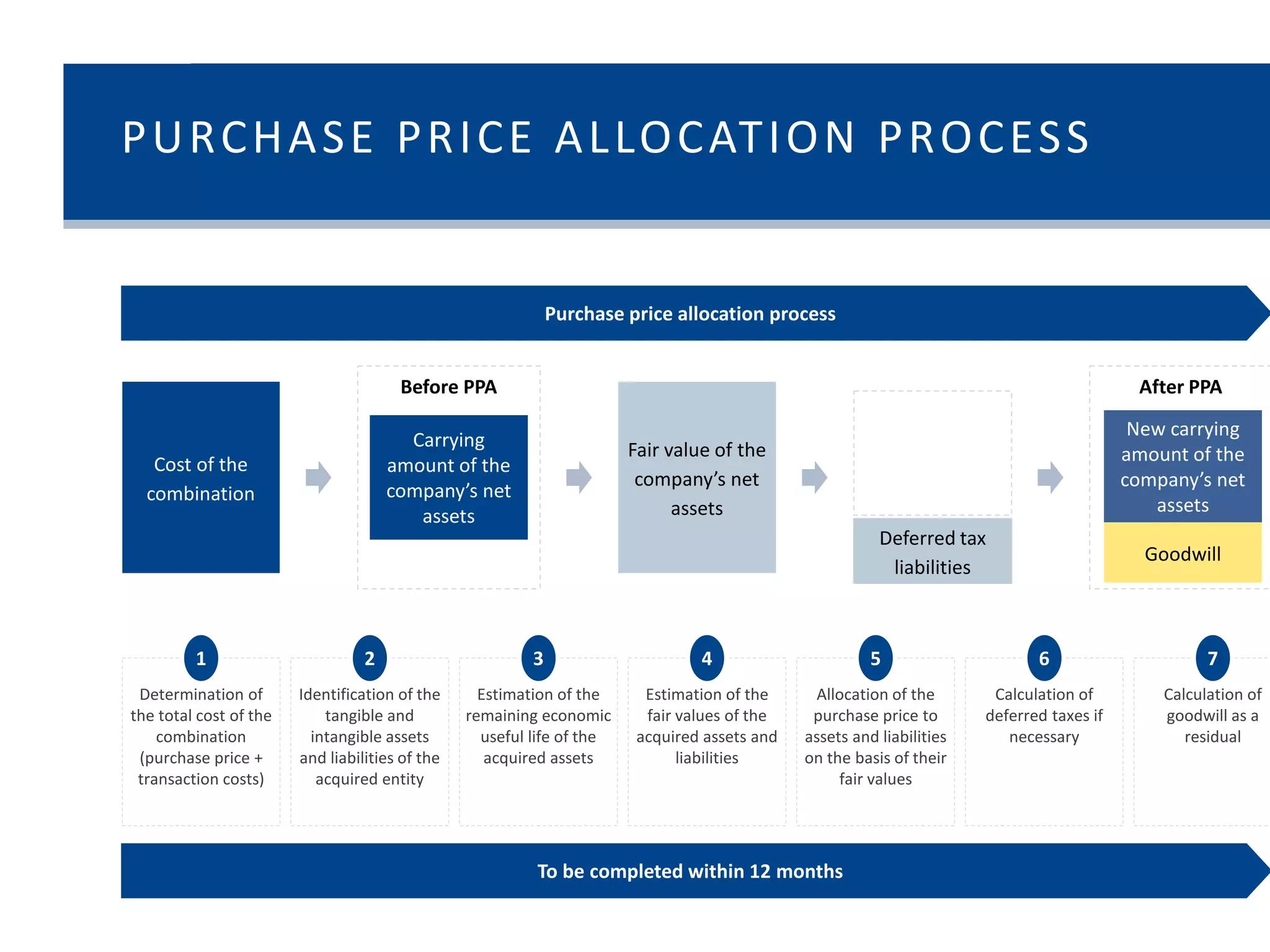
Under accounting standards governing business combinations, the acquirer is required to allocate the purchase consideration among identifiable assets acquired and liabilities assumed. This exercise is known as Purchase Price Allocation (PPA).
While PPA is primarily an accounting requirement under Ind AS 103 – Business Combinations, it has significant tax implications under the Income-tax Act. In recent years, these implications have become even more important because goodwill is no longer eligible for depreciation under the Income-tax Act, 1961 (and correspondingly under Section 33 of the Income-tax Act, 2025), whereas several identifiable intangible assets continue to qualify for depreciation. Section 33 specifically excludes goodwill from the category of depreciable intangible assets.
Consequently, the quality of a PPA exercise can have a substantial impact on future tax deductions, effective acquisition cost, post-acquisition earnings and assessment risk.
Understanding Purchase Price Allocation
What is PPA?
Purchase Price Allocation is the process of allocating the acquisition consideration among:
- Tangible assets acquired.
- Identifiable intangible assets acquired.
- Liabilities assumed.
- Residual goodwill.
The objective is to determine the fair value of each acquired asset and liability as of the acquisition date.
Simplified Illustration
| Particulars | Amount (₹ Crores) |
|---|---|
| Purchase Consideration | 500 |
| Fair Value of Tangible Assets | 220 |
| Fair Value of Liabilities Assumed | (70) |
| Net Tangible Assets | 150 |
| Identifiable Intangible Assets | 250 |
| Residual Goodwill | 100 |
Without PPA, the entire excess ₹350 crore could be classified as goodwill. However, a proper valuation exercise may identify significant intangible assets that can be separately recognized.
Why PPA is Important
Accounting Compliance
Ind AS 103 requires the acquirer to recognize separately from goodwill all identifiable intangible assets acquired in a business combination.
The standard assumes that goodwill is a residual figure and not the first allocation category.
Financial Reporting
A proper PPA affects:
- Future depreciation and amortization.
- EBITDA presentation.
- Earnings per share.
- Return on capital employed.
- Impairment testing.
Tax Efficiency
From a tax perspective, the distinction between goodwill and identifiable intangible assets has become critical.
Historically, taxpayers frequently claimed depreciation on goodwill following the Supreme Court decision in CIT v. Smifs Securities Ltd. However, legislative amendments subsequently excluded goodwill from the scope of depreciable intangible assets. Section 33 of the Income-tax Act, 2025 expressly provides depreciation for specified intangible assets but excludes goodwill.
As a result:
- Value allocated to goodwill generally does not generate depreciation deductions.
- Value allocated to qualifying intangible assets may continue to generate depreciation deductions.
This creates a direct tax impact on acquisition structures.
The Goodwill Depreciation Problem
Position Prior to Finance Act, 2021
The Supreme Court in Smifs Securities held that goodwill constituted a business or commercial right eligible for depreciation.
Consequently, many acquisition structures resulted in substantial tax depreciation claims on goodwill.
Position After Legislative Amendment
The law was amended to specifically exclude goodwill from depreciable intangible assets.
Today:
- Goodwill is not eligible for depreciation.
- Existing depreciation blocks containing goodwill require special treatment.
- Cost of goodwill remains relevant for capital gains purposes but generally not for ongoing depreciation claims.
Practical Consequence
Consider an acquisition involving excess consideration of ₹100 crore.
Scenario A – Entire Amount Classified as Goodwill
| Particulars | Amount |
| Goodwill | ₹100 Cr |
| Tax Depreciation | Nil |
Scenario B – Proper PPA
| Asset | Amount |
| Customer Relationships | ₹35 Cr |
| Brand | ₹20 Cr |
| Technology | ₹25 Cr |
| Non-Compete Rights | ₹10 Cr |
| Goodwill | ₹10 Cr |
In such cases, substantial depreciation may remain available on recognized intangible assets while only the residual amount remains non-depreciable goodwill.
The difference can materially impact the post-acquisition cash flows of the acquirer.
Why Accurate Identification of Intangible Assets is Critical
A weak PPA exercise can create multiple issues.
Loss of Tax Depreciation
The most obvious consequence.
If identifiable intangible assets are not separately recognized, they may become embedded within goodwill and lose depreciation benefits.
Assessment Challenges
Tax authorities frequently examine:
- Basis of valuation.
- Nature of identified assets.
- Whether assets are independently transferable.
- Economic usefulness of assets.
- Supporting documentation.
Poorly documented allocations may lead to:
- Disallowance of depreciation.
- Protracted litigation.
- Penalty exposure.
Financial Reporting Risk
Incorrect classification can distort:
- Amortization expense.
- Profitability metrics.
- Future impairment testing.
Transaction Disputes
In private equity and strategic acquisitions, post-acquisition disputes frequently arise where:
- Expected synergies fail to materialize.
- Intangible assets were inadequately identified.
- Valuation assumptions were not properly documented.
What Constitutes an Identifiable Intangible Asset?
Under accepted valuation principles, an intangible asset is identifiable if it either:
Arises from Legal or Contractual Rights
Examples include:
- Licenses.
- Franchises.
- Distribution agreements.
- Customer contracts.
- Supply agreements.
- Technology licenses.
or
Is Separately Identifiable
Examples include:
- Brands.
- Customer relationships.
- Proprietary software.
- Databases.
- Intellectual property.
- Trade secrets.
Common Intangible Assets Identified in PPA
Marketing Related Assets
Examples:
- Brands.
- Trade names.
- Trademarks.
- Domain names.
Particularly important in:
- FMCG businesses.
- Consumer brands.
- Retail businesses.
Customer Related Assets
Examples:
- Customer relationships.
- Customer contracts.
- Subscriber base.
- Order backlog.
Frequently identified in:
- Financial services.
- Telecom.
- SaaS businesses.
- Healthcare.
Technology Assets
Examples:
- Proprietary software.
- Source code.
- Patents.
- Technical know-how.
- Research and development.
Critical in:
- Technology companies.
- Pharmaceutical companies.
- Manufacturing businesses.
Contract-Based Assets
Examples:
- Distribution rights.
- Franchise agreements.
- Licensing arrangements.
- Supply contracts.
Artistic and Content Assets
Examples:
- Copyrights.
- Publishing rights.
- Media libraries.
- Digital content.
Workforce Related Assets
Although assembled workforce often contributes significantly to enterprise value, accounting standards generally restrict separate recognition in many situations, causing such value to remain within goodwill.
Methods Used to Identify Intangible Assets
Identification is often more complex than valuation itself.
A valuation professional typically undertakes:
Management Interviews
To understand:
- Revenue drivers.
- Competitive advantages.
- Customer dependencies.
- Intellectual property.
Document Review
Review of:
- Contracts.
- Licenses.
- Patent registrations.
- Customer agreements.
- Vendor arrangements.
- Franchise agreements.
Industry Analysis
Understanding:
- Key value drivers.
- Competitive landscape.
- Entry barriers.
- Customer switching costs.
Excess Earnings Analysis
Determining which assets contribute to future earnings and how much value should be attributed to each.
Valuation Methodologies for Intangible Assets
Valuation of intangible assets generally follows three broad approaches.
1. Income Approach
The most widely used approach.
Value is determined based on future economic benefits generated by the asset.
Multi-Period Excess Earnings Method (MPEEM)
Commonly used for:
- Customer relationships.
- Customer contracts.
The method estimates:
- Future cash flows attributable to customers.
- Contributory asset charges.
- Present value of excess earnings.
Relief from Royalty Method (RFR)
Most commonly used for:
- Brands.
- Trademarks.
- Trade names.
The method assumes:
- The owner would otherwise have licensed the asset.
- Royalty payments avoided represent economic benefit.
Value equals the present value of hypothetical royalty savings.
Incremental Income Method
Frequently used for:
- Non-compete agreements.
- Contract rights.
The method compares:
- Earnings with the asset.
- Earnings without the asset.
2. Market Approach
The market approach derives value from:
- Comparable transactions.
- Licensing agreements.
- Royalty databases.
- Industry benchmarks.
Most useful where sufficient market evidence exists.
3. Cost Approach
Value is based on the cost required to recreate or replace the asset.
Frequently used for:
- Software.
- Databases.
- Internal-use technology.
- Certain proprietary systems.
Particularly relevant where future cash flows are difficult to isolate.
Allocation Between Intangible Assets and Goodwill
A common misconception is that goodwill should be determined first.
The correct approach is generally:
Step 1
Determine enterprise value.
Step 2
Identify all tangible assets.
Step 3
Identify all separately recognizable intangible assets.
Step 4
Value each identifiable asset.
Step 5
Allocate residual value to goodwill.
Thus:
Goodwill = Residual Value
and not the primary valuation conclusion.
Areas Frequently Challenged During Tax Assessments
Tax authorities commonly examine:
Customer Relationship Valuations
Questions raised include:
- Expected retention periods.
- Attrition assumptions.
- Revenue projections.
Brand Valuations
Authorities often challenge:
- Royalty rates.
- Brand strength assumptions.
- Useful life estimates.
Technology Valuations
Common areas of dispute:
- Remaining useful life.
- Obsolescence.
- Reproduction costs.
Residual Goodwill
Excessive goodwill balances frequently attract scrutiny where identifiable assets appear to have been overlooked.
Best Practices for Valuation Professionals
A robust PPA exercise should include:
Detailed Asset Identification
Every value driver should be analyzed separately.
Independent Valuation Analysis
Avoid mechanical allocation based solely on management inputs.
Supportable Assumptions
All assumptions should be evidence-based.
Tax Considerations
Consider implications of depreciation eligibility at the valuation stage itself.
Comprehensive Documentation
Maintain:
- Valuation models.
- Interview notes.
- Contract reviews.
- Market data.
- Supporting calculations.
Conclusion
Purchase Price Allocation has evolved from a financial reporting exercise into a critical tax planning and risk management tool. Following the legislative exclusion of goodwill from the depreciation regime, the distinction between goodwill and identifiable intangible assets has become significantly more important. While goodwill generally does not generate depreciation deductions, several identifiable intangible assets continue to enjoy depreciation benefits under the Income-tax Act.
Accordingly, an accurate and defensible PPA can preserve substantial tax deductions, improve acquisition economics and reduce assessment risk. The key lies in a rigorous identification and valuation of intangible assets such as customer relationships, brands, technology, contractual rights and intellectual property before residual value is assigned to goodwill. For valuation professionals, this requires a combination of accounting expertise, tax knowledge, industry understanding and advanced valuation skills to ensure that the allocation withstands scrutiny from auditors, tax authorities and other stakeholders.